
Manolo vs Mondo.
September 11th, 2026.
For the first time ever, two athletes cleared 6.15m / 20’2 in the same world championship.
Mondo went one greater and cleared 6.20m.
Manolo didn’t.
In pole vault, championships are won and records are broken by the slimmest of margins.
So after mastering training, technique, and mindset, how else can you get an edge?
Welcome to Vertical Theory, where I write about proven training principles for pole vaulters. I’m Jak, and I’m here to help you get better as an athlete, as a coach, and as a person.
Were you forwarded this message? You can get the free weekly newsletter here.
Everything you do has a purpose.
Why do you eat clean foods? To become healthier.
Why do you go to bed early? To become well-rested.
Why do you practice? To perform better.
“Eat. Sleep. Game.” – That’s what cheesy t-shirts from the 2010s used to say.
There’s some truth inside that cliché – diet and sleep are crucial for optimal performance. Diet and sleep build health, and without health, you can’t recover.
No recovery, no gains. Max recovery, max gains.
“Eat. Sleep. Vault.” – Perhaps I’ll make that one into a t-shirt.
Clichés aside, to maximize your performance, you first need to optimize your health and recovery.
So let’s dig into a force-multiplying tool for health and recovery:
Dietary Supplementation
In the world of pole vault, champions are decided by a difference of centimeters.
You can never be certain you’ve done enough; someone can always beat you when it counts most. That’s why even a small advantage in training and recovery is worth chasing.
The right supplements, taken in the right contexts, can give you a small edge by adding nutrients to your diet, such as vitamins, minerals, or amino acids.
There are three tiers of supplements you should know about for athletic performance:
Tier 1: Heavy-Hitters
The Gold Standard.
Supplements with heavy research backing and sizable effects on strength and speed training.
— Creatine: Improves muscular strength and power by acting on the body’s energy systems. May allow an athlete to push through 1-2 more reps during training.
— Protein: Provides amino acids for muscle protein synthesis. Helps build bigger and stronger muscles during an energy surplus and retain muscle mass during an energy deficit.
Tier 2: Performance Boosters
Situational supplements with smaller effects.
— Beta-alanine: Raises carnosine in muscle, which helps buffer lactic acid buildup. May help with hard workouts.
— Sodium Bicarbonate: Acts as a buffer in the blood, neutralizing acid produced during intense exercise. Helps most at around 1 minute of continuous exercise.
Tier 3: Foundation Fixers
Supplements that fix common nutritional deficiencies.
— Vitamin D: Supports bone health along with muscle and immune function.
— Omega-3s: Supports heart, brain, and nerve-muscle function.
— Iron: Supports muscle function and energy production, and carries oxygen in your blood.
One honorable mention: Caffeine. I omitted it from Tier 1 in the list above because it’s a psychoactive drug, not a nutritive supplement (albeit a legal drug – WADA removed it from its banned substances list back in 2004).
This week, a deep dive on the number-one supplement on the tier list: creatine.
Creatine: The G.O.A.T.
Creatine is the most effective and best-supported muscle-building supplement in the world. It makes you stronger and more powerful.
Creatine is a nutrient, not a drug. It is found naturally in foods such as red meat and fish. Your body also synthesizes creatine in the liver and kidneys from three amino acids: arginine, glycine, and methionine.
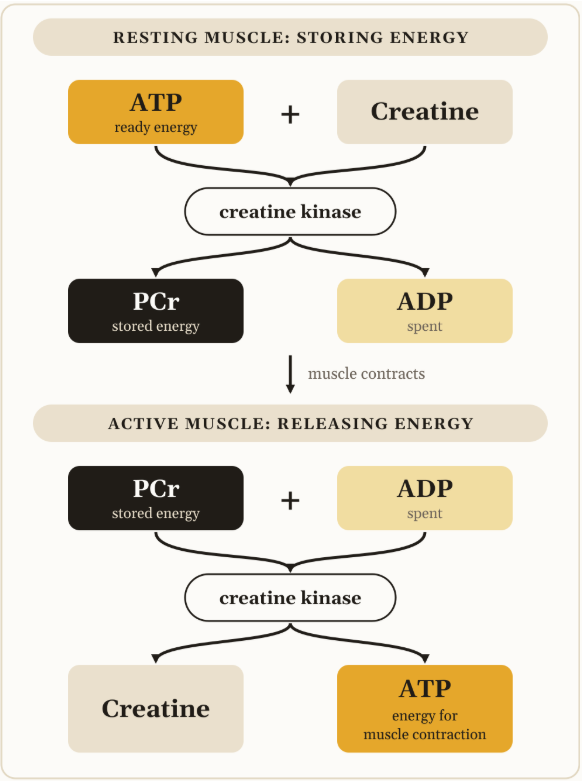
Creatine is then carried by the bloodstream and supplied to muscles all around the body. Inside the muscle, an enzyme called creatine kinase uses ATP to attach a phosphate molecule to creatine, forming PCr (phosphocreatine).
ATP is the energy molecule of the body. When a muscle contracts, ATP breaks down into ADP and releases the energy that powers the contraction. Muscles hold a small supply of ATP, so as it gets used up, creatine kinase quickly moves the phosphate from PCr back onto ADP, rebuilding ATP and leaving creatine behind.
The result is this: you have more energy for muscular contractions when you need it most.
You can think of PCr as a kind of “battery”: energy storage for your muscles.
Most omnivores store about 120 mmol of creatine per kilogram of dry muscle (muscle with the water removed), roughly 75% of what muscle can hold. The ceiling is about 160 mmol/kg. Every day, the body breaks down about 1 to 2% of its creatine into a waste product called creatinine, which the kidneys filter into urine. For an average man, that’s roughly 2 grams a day. Your body synthesizes about 1 gram a day, and a typical diet supplies about 1 to 2 grams more, which is why stores hold steady around 75%. In practice, diet and supplements together can raise stores to about 90% of that ceiling, around 140 to 145 mmol/kg.
Creatine is a bit different from other nutrients because it takes a massive amount of creatine-containing food such as red meat to hit that 90% mark. Raw beef contains only 2 grams of creatine per pound, and roughly a quarter is destroyed during the cooking process. To reach 90% saturation, you would need to eat about 3 pounds of raw beef every day. That’s about 2,500 calories in meat alone, which is impractical for almost every diet.
A supplement is far easier. The standard dose is 3 to 5 grams a day, every day.
In a study that tested 3 grams a day, muscle neared saturation after 28 days, with most of the gain in the first two weeks.
When starting creatine, a larger dose can complete saturation in as little as a week. Researchers often use a loading phase of 20 grams per day for 5-7 days. Many do this because they have time constraints on their studies.
If you use a loading phase, consider splitting the daily 20 grams into four 5-gram doses, and take them with food. Creatine uptake is facilitated by insulin, so supplementing just before or after eating can make it easier for your body to absorb it. The faster loading phase is an option, but not required; the standard dose reaches the same saturation limit in about four weeks.
So once your muscles reach the 90% saturation point, what can you expect?
The Wingate Test
When creatine bolsters your body’s battery, you can push hard for slightly longer. You may experience ever so slightly better workouts, barely noticeable at first, but making a sizable difference in the long run.
One of the best ways to see how creatine works is the Wingate test. This exercise is an all-out sprint on a stationary bike for 30 seconds straight.
Two important metrics are recorded:
— Peak power: the highest power output at any time in the test.
— Mean power: the average power output across all 30 seconds.
Mean power is the clearer window into what creatine does, since it shows what happens when PCr stores start running low.
In a 2026 meta-analysis, creatine was shown to raise Wingate mean power by about 40 watts. This translates to a gain of about 5-7% in favor of creatine, assuming typical power production for young men. The effect was similar in studies with and without resistance training.
Individual studies show gains of roughly 3 to 8%: about 2.5 to 4% in young soccer players after four days of loading, and 7.6% in untrained young men across five back-to-back sprint tests.
This makes sense because PCr runs low quickly. By the end of a 30-second sprint, PCr had fallen to about 20% of its resting level, and in a second sprint it was almost completely used within the first 10 seconds. Once a sprint passes that point, a bigger store gives the muscle more to draw on. In one repeated-sprint study, peak power didn’t change, but participants held their power better in the final seconds of each sprint.
Peak power also rises with creatine. In the same 2026 meta-analysis, Wingate peak power increased by about 71 watts, roughly 6 to 8% assuming a typical peak of 900 to 1,200 watts. The paper rates this result as high certainty.
Peak power is harder to explain. It’s typically hit within the first 3-5 seconds of an all-out sprint, before PCr stores become depleted. However, PCr may not have to run out completely to limit power. As stores fall, the muscle may rebuild ATP more slowly, so the energy supply could already be tightening at the peak.
In a classic sprint study, PCr fell by more than half within a single six-second sprint and supplied about half the energy. A bigger store could plausibly keep ATP resynthesis higher early in the effort. Still, controlled trials haven’t confirmed the mechanism.
Squat and Bench
If there’s just one exercise for upper body strength, it’s the bench press. If there’s just one for the lower body, it’s the squat. These two compound exercises and their variations are the bedrock of what it means to be strong.
“When I started lifting, I held a simple philosophy. There’s no way I could get strong as fuck without getting jacked. Show me someone who squats 400lbs who doesn’t have jacked legs. Show me someone who benches 315 and isn’t swole. You can’t, because they don’t exist. If you’re strong and lean, you’re jacked, it’s as simple as that.” – Greg LaVecchia
There’s good reason squat and bench reign supreme. Both move several joints and train several muscle groups at once. In the squat, the quads and glutes drive the lift. Simultaneously, the lifter has to brace his trunk muscles and squeeze his back to keep the bar balanced, making the squat one of the most stimulating exercises for the full body.
Similarly, the pecs and triceps do most of the work during the bench press. The front delts also activate, and the lifter needs to brace his legs and back to make the most of the movement.
Research shows just how effective these lifts are for building muscle and athleticism:
– In an 8-week study, resistance-trained men trained the squat and bench press three times a week. They got stronger, and their pecs and quads grew.
– A 2023 meta-analysis compared multi-joint exercises (compound movements such as bench press and squat) and single-joint exercises (isolation movements such as bicep curls). Programs that implemented multi-joint exercises only saw similar results to those that combined multi-joint and single-joint exercises, so the big lifts did the job on their own.
– A 2014 meta-analysis found that bigger gains in squat strength went along with bigger improvements in sprint time in training studies.
– A 2016 study found that squats increase squat jump and countermovement jump more than leg press. The authors concluded “if the strength training aims at improving jump performance, the squat should be preferred because of the better transfer effects.”
Creatine has been shown to increase squat and bench press strength. Two meta-analyses of placebo-controlled trials found that creatine improved lower body strength across 60 studies and upper body strength across 53 studies. The effects were modest and consistent, with effect sizes of roughly 0.2 to 0.3.
There are two mechanisms that may explain how:
1) a direct increase in peak power production via the PCr pathway as previously discussed, and
2) more training volume, made possible by an increase in mean power production via the PCr pathway, leading to superior training and superior end results. This is the indirect effect.
The second point comes down to training volume. Most training programs involve multiple sets of the same exercise at submaximal loads. For example, a lifter doing 3 sets of 10 on the bench press may take each set to failure. With creatine, he may squeeze out an extra rep each set because of the PCr pathway. That adds training volume, which has been linked to greater muscle growth. This muscle growth may be reflected as greater strength on a 1RM test.
Either way, creatine improves the biggest lifts, and the biggest lifts improve speed and athleticism. It follows naturally from this that creatine should improve speed and athleticism. Have any studies tested this directly? Luckily, one has: Kirksey 1999
The Kirksey Study
Kirksey et al. (1999) is especially relevant to vaulters: a double-blind, placebo-controlled trial of creatine and vertical jump performance in collegiate track and field athletes.
The sample included 36 jumpers, sprinters and throwers of both sexes, split into two groups. Both creatine and placebo groups performed the same training: a speed workout twice a week, and weight training three times a week. Below is the speed program:
6 x 100m on Tuesdays
6 x 150m on Thursdays
Each rep is a sprint with 90-120 seconds rest.
The weight room exercises “consisted primarily of large-muscle mass movements,” which I believe to be in reference to compound exercises such as the squat, pullups, and bench press.
Kirksey and colleagues supplemented the creatine group with roughly 20 grams per day for six weeks. They took measurements before and after the six-week intervention for body mass and body fat percentage, total calorie intake and macronutrient profiles, and six athletic markers including countermovement vertical jump, static vertical jump, ergometry peak power, and ergometry mean power.
Creatine produced superior gains in countermovement jump height (7.0% vs 2.3% for placebo), jump power index (6.8% vs 3.1%), and cycle ergometer power. Static jump narrowly missed significance (p = 0.07).
The power production phase of static and countermovement vertical jumps takes less than one second, not nearly enough time for the PCr pathway to become even partway depleted. A direct boost to peak power is unlikely. The authors instead point to the indirect route: “When creatine monohydrate is used in conjunction with a proper sport-specific training program, athletes could have a higher training capacity and therefore show greater improvements in performance of those tasks specific to their event.”
Several other studies have also shown positive effects of creatine on vertical jumps and sprint speeds.
— A 2001 study found creatine increased sprint performance in male sprinters.
— A study from 2004 found creatine improved vertical jump height and sprint power in male soccer players.
— A 2025 meta-analysis of randomized trials found creatine improved vertical jump by about 1.5 cm more than placebo (p = 0.01).
For jumps, the training-volume explanation is viable. Sprints commonly last longer than 5-7 seconds, so both the direct PCr effect and the training-volume effect make sense.
However, there are studies that found no clear effect on vertical jump, such as a 7-week study in elite Brazilian soccer players, where the difference between creatine and placebo was not statistically significant. Still, the creatine group came out ahead (+2.4% vs −0.7%).
Overall, the evidence points to a modest, favorable effect for athletic performance, but it is less consistent than the evidence on strength and muscle gain.
Good news. So what does it mean for pole vaulters?
Creatine for Vaulters
Creatine has one important side effect: weight gain.
Studies report an average weight gain of about 2 pounds, mostly in the first weeks and mostly in the form of intracellular water weight. Creatine draws water into the muscles, which is why supplementing increases water retention.
Vault height is heavily impacted by the strength-to-bodyweight ratio. You want to be as strong as possible and as light as possible. Any weight that is not helping, is hurting. And the water retention caused by creatine does not help.
Therefore, creatine has a direct tradeoff: gain strength, and you gain water weight. The first is good, the second is bad. Both are small effects. Neither clearly outweighs the other.
For this reason, I do not believe creatine is necessary for pole vaulters. For throwers, it’s a no-brainer. For sprinters, likely. For pole vaulters, in an event where we fling our bodies in the air, and pole selection is determined by bodyweight, it’s a harder sell.
The weight gain is exactly the reason why I never took creatine as a collegiate athlete; it was very important that my bodyweight stayed within the 173-178lb range during competition season. I’d get dramatically less pop off my top end when I was heavier than that.
Nevertheless, keep creatine in mind. One strategy may be to supplement during the offseason and preseason, then come off it during competition season. It’s harder to build strength and power than it is to maintain it. If you build it before the season, then you could come off creatine and lose the water weight while keeping some of the strength. A 1996 study found that muscle creatine levels return to baseline about 4 weeks after stopping.
Apart from water weight, creatine has very few side effects and is regarded as one of the safest supplements in the world, with one caveat: A 2009 study is frequently referenced as evidence that creatine can induce hair loss in men. The common argument is that creatine increases DHT, and DHT induces hair loss. However, this stance has since been challenged by a 2025 randomized trial that measured hair directly and found no difference between creatine and placebo. Personally, I find the evidence for creatine-induced hair loss lacking and wouldn’t worry about it.
So there you have it: the G.O.A.T. of the supplement industry and its application to pole vaulters. My two cents: creatine works as advertised. However, the water retention makes it a tradeoff instead of straight upside. Take it or don’t take it, but either way get after your training and make it happen.
Until next week,
– Jak
