
Bigger.
Faster.
Stronger.
If you want to develop a physical edge, you’re in the right place.
You have to be the strongest to be the best, and this week you’ll learn the strength training principles needed to unlock your greatest potential.
Welcome to Vertical Theory, where I write about proven training principles for pole vaulters. I’m Jak, and I’m here to help you get better as an athlete, as a coach, and as a person.
Were you forwarded this message? You can get the free weekly newsletter here.
This week’s topics:
– Progressive overload
– Muscle protein breakdown and synthesis
– Mechanical tension
– Training volume
– Recovery
Progressive Overload
Go on any fitness website or YouTube channel and you’ll hear the same word repeated over and over: progressive overload.
Perhaps the most famous example dates back to ancient Italy, 6th Century B.C. The legendary wrestler Milo of Croton started carrying a calf on his back every day as part of his training. Each day, the calf grew a bit bigger, and Milo had to become stronger to continue lifting him. By the time the calf became a bull at 4 years of age, Milo was stronger than all of his competitors, and he went on to win the Olympics six times in a row.
Progressive overload means that you can lift more weight this time than you did last time. It can be measured by lifting more weight with the same number of reps, or by doing more reps with the same weight.
For example, say you’re training the bench press. You’re on a four-month program where you’re supposed to lift a set weight for as many repetitions as you can, twice a week. You’re logging your progress in a spreadsheet, and the first day you get the following:
Set 1: 10 reps at 135
Set 2: 7 reps at 135
Set 3: 5 reps at 135
Total: 22 reps at 135
The next day, you lift roughly the same.
But the day after that (one week after the first day), you may start seeing some results.
Set 1: 12 reps at 135
Set 2: 8 reps at 135
Set 3: 5 reps at 135
Total: 25 reps at 135
You did 3 more reps in the second week than the first week. “Gains!” you might be thinking, but progressive overload refers to strength increases across months, not just week-to-week.
If you haven’t trained the bench press intensively, these initial gains within the first few weeks of training are likely due to neuromuscular adaptation, which is a big fancy word for saying you got better at the ‘skill’ of bench pressing. Three quick ways you may have gotten better:
– You braced your back by squeezing your lats together before unracking, putting a nice stretch on the chest and pre-loading the weight.
– You controlled your breathing by exhaling just after the bottom of the movement when the bench press is at its most difficult.
– You guided the weight down with a 45 degree angle between your torso and your elbows, allowing for greater muscle fiber recruitment across the chest, shoulders, and triceps.
None of these reasons actually made you bigger or stronger, and none of them are likely to transfer to pole vault.
But don’t be discouraged; once you’ve done enough repetitions to master the movement, then the real work can begin. Research has shown that “hypertrophy,” which means muscles actually get bigger and stronger, becomes the dominant factor in strength gains after 3-5 weeks.
Hypertrophy is what you’re after as a pole vaulter. Bigger muscles are stronger muscles, and building strength in the right places will make you faster and more powerful during the run, plant, and swing phases.
Muscle Protein Breakdown and Synthesis
When you train, your body breaks down small portions of muscle “fibers,” which are individual muscle cells that contract and extend to “flex” or “relax” the muscle. Muscle fibers are made of protein, mostly actin and myosin. When they’re broken down, the proteins are converted into amino acids. This breakdown process is called muscle protein degradation (MPD), also called muscle protein breakdown.
But training also produces the inverse effect; the stimulus prompts your body to assemble amino acids and make existing muscle fibers bigger. The creation of new muscle is called muscle protein synthesis (MPS).
When the rate of MPS is greater than the rate of MPD, you gain muscle. When MPS is less than MPD, you lose muscle. With proper training protocols, you can raise MPS greater than MPD, resulting in net muscle gain (hypertrophy).
Mechanical Tension is how much force muscle fibers fire with during resistance training.
High mechanical tension is reached by training hard. When you finish a set because you’re physically not able to perform any more repetitions, you have reached what we call “failure.” That’s good because training to failure produces high amounts of mechanical tension. Sets taken to or close to failure are called “hard sets.”
Training close to failure is effective with high reps or low reps. Low rep ranges are typically 2-7 reps, and high rep ranges are 8-20 reps, or more.
In a 2015 study, Schoenfeld et al. compared sets taken close to failure in the 25-35 rep range and in the 8-12 rep range. Both groups showed similar gains in hypertrophy, although the 25-35 rep group showed greater muscle endurance, and the 8-12 rep group showed greater 1RM strength. Low rep ranges have been shown to be even more effective for building strength: Kubo et al. (2021) and Schoenfeld et al. (2016) have demonstrated lower rep ranges continue to produce greater strength gains down to 2-4 reps.
These differences in endurance and strength are likely due in part to neural adaptation, so switching from higher reps to lower reps should result in a fast strength increase. A balanced strength program may train in high or low rep ranges during the offseason and preseason, but should always train low rep ranges during competition season to build strength for the short, powerful movements performed in pole vault.
But no matter what rep range you’re training in, remember: always take your sets to failure, or at least close to it.
However, most athletes are only capable of doing a few hard sets before fatigue sets in and plateaus any further progress. So the question becomes: how many sets should you do?
That takes us to our next principle:
Training Volume
Most athletes follow a full-body training program. Legs, core, and upper body are all trained in the same session, typically 2-4 days a week.
Volume is measured by how many hard sets are done. In a full-body program, you can calculate volume by adding up the number of sets per body part in each training session in the week.
As a general rule, doing more sets will result in greater strength and size gains.
But there’s an important catch: Schoenfeld et al. 2019 found that strength gains plateau at lower volumes than size gains. This is a critical finding for pole vaulters. Other than technique, the next most important factor in pole vault performance is the “strength-to-bodyweight ratio.” The ratio of how strong your muscles are to how much you weigh determines how many pullups you can do, for example. Also: the ratio of hamstring strength and rate of force production to how much you weigh determines how fast you can run. Pole vaulters succeed when their body clears the bar, so strength only helps if it exceeds the corresponding bodyweight gained for it.
In that 2019 Schoenfeld study, resistance-trained men who did just 6 hard sets for the upper body and 9 hard sets for the lower body per muscle per week gained about as much strength as those doing up to 45, while muscle size kept rising with more sets. For strength-to-bodyweight ratio, that makes 6-9 hard sets a good starting point.
But also note that the study lasted 8 weeks, so it’s possible that the greater hypertrophy experienced by the high-volume group could later translate into greater strength gains.
Anecdotally, I’ve found the sweet spot to be 6-12 hard sets per muscle group per week, split across 2 or more nonconsecutive days. This is enough volume while leaving room for recovery.
Say your program trains back squat, overhead press, chinups, hamstring curls, and dragon flags. These each train different body parts: squats for legs, overhead press for shoulders and triceps, chinups for back and biceps, hamstring curls for hamstrings, and dragon flags for abs.
You’ll want to dedicate more sets toward the body parts you want to develop according to your goals. You’ll also want to train these most important body parts first.
For most vaulters, I would recommend the squat first, then OH press and chinups, then hamstring curls and dragon flags. This is because lower body strength leads to greater runway speed, and thereby leads to greater vault heights. Next most important are the OH press and chinups, superset together for time efficiency, because upper body strength contributes to the plant and swing phases of the vault. Finally, dragon flags and hamstring curls are isolation exercises (meaning just one body part), and they’re included to work on common weak spots. These can also be superset together for greater time efficiency.
Dragon flags build a strong core that is essential for all phases of the vault. Unless you have an extensive gymnastics background, additional core strength training is going to be a huge unlock for you.
Hamstring curls prevent nasty hamstring strains, which you’re statistically likely to experience as a pole vaulter. The best way to stay injury-free is with preemptive strength training. Unfortunately, I have a lot of experience dealing with injury to the hamstrings. If you’d like to learn more, I wrote a narrative about hamstring strengthening here.
Weekly Volume
The below table breaks down how many sets to do for how many training days in a week.
The first number is sets per session, the second in parentheses is frequency multiplied by that to yield total sets per week, e.g. 4 sets (8) = 4 sets per session, 8 sets total per week.
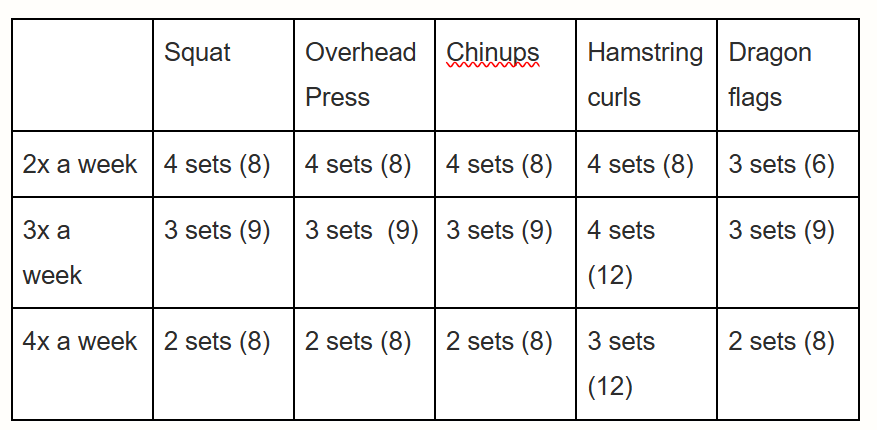
Note that 3x a week has the highest weekly training volume across all exercises. I believe 3x a week is the perfect frequency because it’s the highest possible while allowing the muscles a full 48 hours to recover. This way, you can take more sets close to failure while still feeling fresh for the next session.
My program above also puts a big emphasis on hamstring strength because that’s the body part that I have injured the most. For your specific program, add more sets to exercises that train your weak spots. When it comes to injury prevention, I’ve found strength training to be the best way to get healthy and stay healthy. But of course, to stay healthy you need to pair strength training with proper recovery, which takes us to our last section:
Recovery
The final principle of strength training has changed definition in recent years. “Recovery” used to only refer to the distribution of volume; if you don’t train one day, that day is a recovery day.
The modern definition is very different. Recovery now refers to everything you do outside of strength training to enhance your progress.
There are three big factors impacting recovery: diet, sleep, and exercise.
Exercise is already covered with pole vault and weight training, so I’ll briefly cover the other two.
Diet
First, let’s revisit muscle protein breakdown and synthesis (MPD and MPS). When MPS is greater than MPD, muscle is gained, and strength is gained with it. When your body converts amino acids into muscle during MPS, it needs an adequate amount of amino acids to draw from. There are 20 standard amino acids. Nine of these are “essential amino acids,” which means your body is unable to synthesize them. These nine essential amino acids need to come from food.
The best way to get amino acids is by eating foods high in protein. Dietary protein is broken down, then transported and synthesized into muscle. High-quality protein contains all nine amino acids, and typically comes from animal sources such as red meat and chicken, or from whey protein powder.
Other protein sources include plants such as lentils, beans, and rice. Plant proteins are typically low in leucine and one or two other essential amino acids, so when counting dietary protein, count only high-quality sources.
So how much protein do you need? The answer depends on your bodyweight. Scientific research has shown that muscle gains increase with protein intake up to about 0.75 grams of protein per pound of bodyweight. So if you’re 120 pounds, you should get 90 grams of protein per day. If you’re 160 pounds, you should get 120 grams, and so on.
Because protein contains 4 calories per gram, 120 grams of protein is 480 calories and should be relatively easy to hit in any diet. For context, a Muscle Milk contains 42 grams of protein in 240 calories. For a 160 pound person, 3 Muscle Milks would hit the protein requirement for the day.
Now, I don’t recommend that you drink 3 Muscle Milks a day (I think your gut would explode), but personally I like to keep half a dozen in the fridge. Any day I’m low on protein, I just drink one before bed for a quick protein boost.
If you’ve never tracked calories before, I’d recommend using an app like MacroFactor on the one-week free trial just to get a feel for how many calories and protein the foods you consume have. This is the best way to see what foods you may need to eat more of to hit your daily protein goal.
Besides protein, there are two other macronutrients: carbohydrates and fat. Most protein sources like eggs, dairy, and red meat also contain adequate amounts of fat, so most people don’t have to worry about fat intake.
The lever to pull is carbohydrates, which are your body’s main source of energy during training. Carbohydrates are converted into glucose, which is then broken down into energy in the form of ATP for muscle contractions. Carbs are found in grains like rice and oats, starches like potatoes, and fruits like apples, bananas, and strawberries. Processed foods like cookies and other refined flour products are also mostly carbs, but they typically provide less fiber and micronutrients than whole foods.
Eating more carbohydrate-heavy foods while maintaining the 0.75 g/lb protein requirement will result in weight gain. Eating less will result in weight loss. Not all of the weight gain will be muscle, and not all of the weight loss will be fat.
When I was at the University of Minnesota, I liked to eat more carbs during the offseason and preseason, then eat less during the competition season. My weight would come down from 185lb in the summer to 175lb in the spring. Even with a high protein intake and hard training, I still lost some muscle during the transition. I could tell because my strength in the weight room decreased. It was worth it, though, because personally I jump better at the lower bodyweight. Remember, peak pole vault performance is determined by strength-to-bodyweight ratio. The optimal bodyweight is going to be a bit different for everybody; lose too much weight, and strength suffers. Gain too much weight, and strength fails to increase proportionally. Your body has a set optimal weight for competition, and it might take some experimentation to figure out what is right for you.
Also: micronutrients. If you eat whole foods, you likely get most vitamins and minerals you need from your diet, but you may have some gaps. It’s worth scheduling a blood test with a physician to check if anything is low. Omega-3 fatty acids and vitamin D are commonly low in athletes. Both are found in fatty fish such as salmon. Beyond these, a physician can tell you what nutrients may be low, and you can adjust your diet or supplement accordingly.
One more thing: alcohol has been shown to directly hinder muscle hypertrophy. A 2014 study found that 12 Australian drinks (equivalent to 8 standard US drinks) reduced MPS by 24% even with concurrent protein consumption. Cut alcohol consumption to a minimum, or better yet cut it entirely.
Sleep
A 2021 study found that sleep deprivation decreased MPS by 18%. Pulling all-nighters can result in an acute decrease in muscle hypertrophy. This result is expected; we know that nights with no sleep are bad for the human body, and the body will eventually shut down during chronic sleep deprivation. But what about sleep restriction, where only a few hours are allocated for sleep instead of the full 8-9?
Sleep alternates between two phases: REM sleep and non-REM sleep. REM stands for Rapid Eye Movement. REM sleep is when vivid dreams occur. Muscles are paralyzed, and eyes move rapidly beneath the eyelids.
Non-REM sleep has three stages: N1, N2, and N3. N1 is the first stage, reached a few minutes after drifting off. N2 is light sleep, and is the most common sleep stage during the night.
N3 is a deep, dreamless sleep. Most physical restoration is done in N3. This stage is when growth hormone is released, the nervous system shifts into recovery mode, and recovery processes ramp up.
Interestingly enough, when sleep hours were cut from 9 hours to 4 hours, researchers found that time spent in N2 and REM sleep was reduced, but N3 sleep was preserved.
Saner et al. 2020 found a decrease in myofibrillar protein synthesis after restricting sleep to 4 hours for 5 nights, relative to a normal-sleep control group. However, the same study also tested exercise + sleep restriction, and found that myofibrillar protein synthesis was not decreased when combined with exercise.
A reduction in sleep time to the 5-7 hour range seems to have little effect on muscle growth, but that’s not to say bad sleep is harmless.
– A 2013 study found restricting sleep to 5 hours impaired serving accuracy in tennis players.
Looking at the research, it seems to me that recovery processes such as MPS can function with only 5-7 hours of sleep, although I haven’t found a study that tests this directly. More sleep than that may decrease injury risk and improve performance markers such as accuracy and reaction time. A full night’s sleep may be important before a meet or practice, but the evidence for its effects on muscle hypertrophy is thin.
Improving Sleep
If you struggle with sleep quality or get sleep disturbances, you may be interested in this study. Researchers found that eating kiwis before bed may improve sleep quality and increase the proportion of time in bed spent actually sleeping; however, the authors note they couldn’t rule out expectancy effects because there was no placebo group.
Here are 3 more quick ways to improve sleep quality:
– Lower temperature at night to 65-68 degrees Fahrenheit.
The National Sleep Foundation identifies 65-68°F as optimal for most adults, and a 2012 review found heat exposure increases wakefulness and decreases slow wave sleep and rapid eye movement sleep.
– Reduce light exposure 3 hours before bedtime, especially blue light (no doomscrolling before bed).
A 2022 expert consensus recommends keeping evening light dim 3 hours before bed, and a 2011 study found that room light before bedtime shortens the duration of melatonin, a sleep-promoting hormone, though the effect on measured sleep is less clear.
– Make your bedroom as dark as possible.
In a 2022 study, one night of moderate (100 lux) ambient light during sleep impaired cardiometabolic function. Use blackout curtains if light enters your bedroom through windows.
Aim for at least 5-7 hours of high-quality sleep for strength training progress, and get the full 8-9 when you can.
Here’s what to take from this week’s article. Pick one and start implementing it:
1. Progressive Overload: Get Stronger Over Time
Progressive overload means lifting more weight over time. Early gains come mostly from your nervous system learning the movement. After about 3-5 weeks, muscle growth becomes the bigger factor in strength gains. Log your lifts and try to beat last month’s numbers.
2. Muscle Grows When Synthesis Beats Breakdown
Training breaks down muscle protein (MPD) and triggers your body to rebuild it (MPS). When synthesis outpaces breakdown over time, you gain muscle. Take all working sets close to failure to create the mechanical tension that drives growth. Use high or low rep ranges in the offseason and preseason, then low rep ranges for strength during competition season.
3. More Hard Sets Build More Muscle, but Strength Favors Lower Volumes
Doing more hard sets generally builds more size, but strength gains plateau at lower volumes than size gains, which matters for keeping the strength-to-bodyweight ratio high. Aim for 6-12 hard sets per muscle group per week, split over two or more days.
4. Eat ≥0.75 g/lb of Protein a Day, Every Day
Muscle gains rise with protein intake up to about 0.75 grams per pound of bodyweight (90g at 120lb, 120g at 160lb). Carbohydrates are the lever for increasing or decreasing bodyweight. Keep protein intake at or above 0.75 grams per pound every day, and optionally adjust carbs as necessary to induce a weight difference between offseason/preseason and competition season.
5. Sleep: 5-7 Hours Minimum, 8-9 When You Can
All-nighters harm muscle growth. Short sleep has been linked to worse accuracy, worse reaction times, and more injuries. Aim for at least 5-7 hours of high-quality sleep every day, and get the full 8-9 hours when you can.
Get after it this week. You have what it takes.
Until next week,
— Jak
